Big Ambitions — Your First Hour
The order Big Ambitions expects you to do things in: earning a first wage, picking a building by traffic index, and what a shop needs before it can open.
Community sourcesCurrent for 1.0 Build 3672
GamePrimer EditorialUpdated Verified
Earn a wage before you rent anything. Big Ambitions starts you at eighteen with an empty account in a downtown apartment, and a business needs a deposit, rent, fixtures and stock before it takes a single dollar. Get income first, then rent the smallest retail unit with the highest traffic index you can reach.
The tutorial walks you through opening a shop. It is much quieter about the order everything else happens in, and the order is what decides whether your first business survives its first week.
1. Get money coming in before you spend any
You begin in your parents’ apartment with nothing in the bank. There are two honest sources of early cash:
- Take a job. Working for someone else pays a wage while you learn the city. It is also possible to be fired — Hovgaard added a rule in the first post-1.0 patch preventing you from being rehired for 30 days if Jose fires you from El Gato.
- Run Speedy Bites deliveries. Food delivery arrived with 1.0, and the studio explicitly framed it as a way to make quick cash as well as a service to order from.
Loans are not the shortcut they look like. The 1.0 banking rework raised the income you need to qualify, raised interest rates and raised minimum daily payments. Since Build 3672 the bank will at least tell you how much you can actually borrow instead of just refusing.
2. Pick the building, not the business
Every rentable unit has a traffic index, and it is the one number you cannot change later. Traffic index combines with your marketing spend to set how much of the potential customer base actually walks in — so a high-traffic unit is permanently cheaper to promote than a low-traffic one with the same rent.
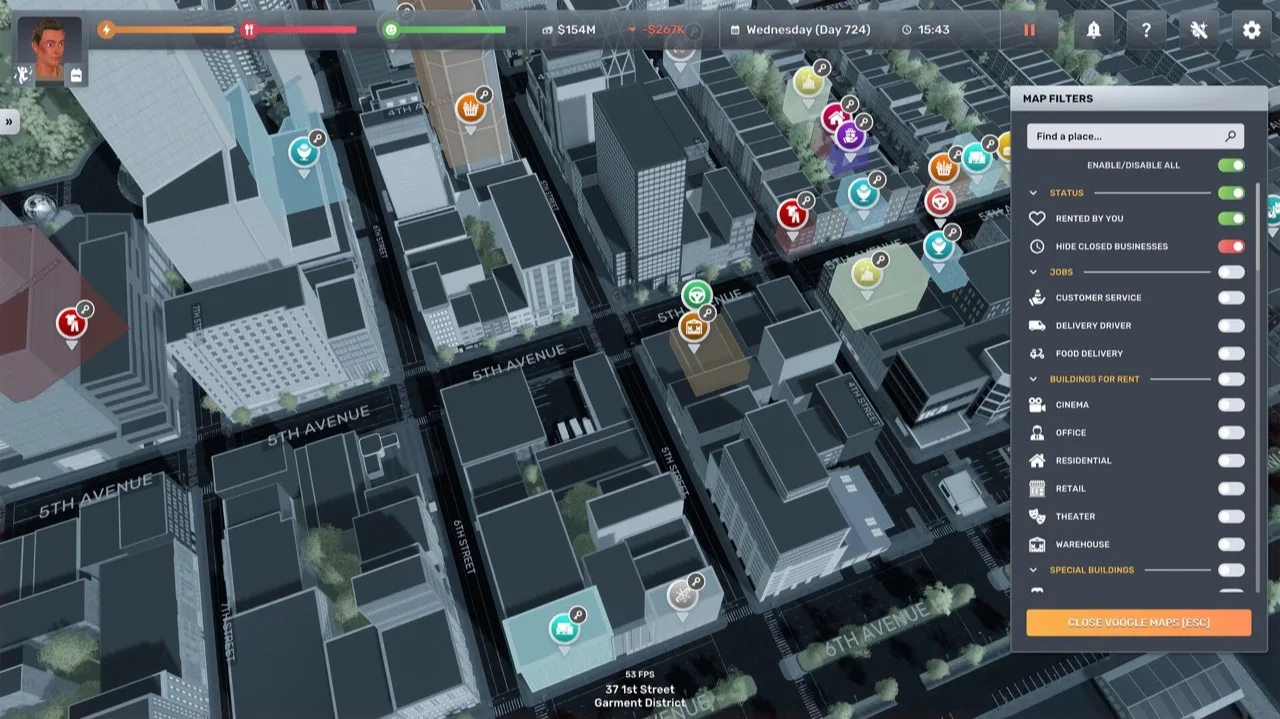
Buildings are labelled with a code that fixes their size and customer capacity. For retail, the codes run:
| Code | Size | Customer capacity |
|---|---|---|
| A1 / A2 | 75 m² | 15 |
| C1 / C2 | 225 m² | 30 |
| D2 | 285 m² | 40 |
| M1 | 1000 m² | 75 |
Offices use a separate set (A3, C1, C2, D2, J1, K1), warehouses and factories another (H, I, P, Q),
and homes another again (B1, F1, L1, N1). The code is worth learning early for a second reason: a
Workshop blueprint only loads into a building of the code it was saved from, so an A1 layout is
useless to you until you rent an A1. The mods page covers that half of
the Workshop.
Start at A1. A 75 m² unit is cheap to furnish and cheap to stock, and customer capacity 15 is not the thing limiting you in week one — cash is.
3. Know what the shop needs before you sign
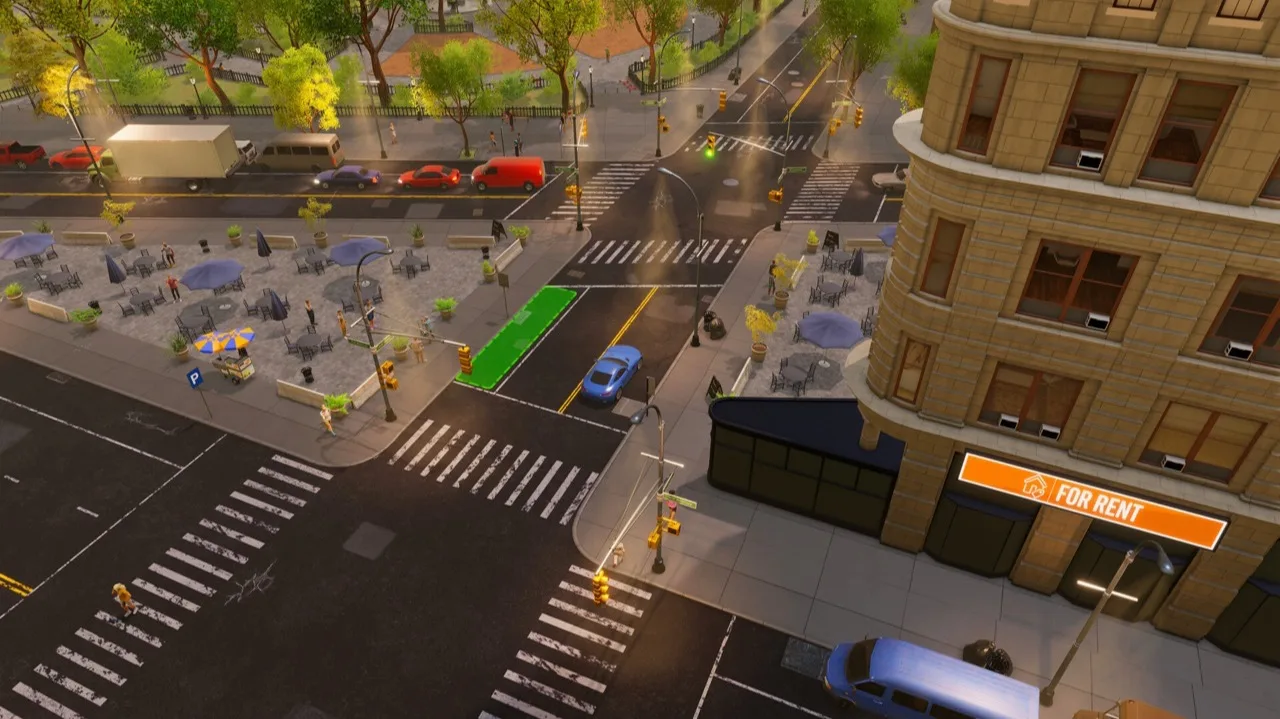
A retail business will not open until it has the fixtures its type requires. A gift shop, the lightest of them, needs a stack of shopping baskets, a cash register or checkout counter, and at least one main product to sell. Every other retail type asks for more — display fixtures matched to the goods, and in some cases a security guard once you stock anything valuable.
That requirement list is why the first shop is usually a gift shop or a gym rather than something that sounds more profitable. Gyms are worth a second look specifically because Hovgaard boosted them in the last Early Access update: they were given soda and energy drinks to sell without needing an extra employee, which the studio said was meant to make them viable for early income.
4. Hire from the right agency
Staff come from two recruiters, and which one depends on the skill:
- Anderson Recruitment Corp — cleaning, customer service, delivery drivers. Customer service staff also carry a cleaning skill, so one hire can cover both jobs in a small shop.
- City Workforce Inc — lawyers, purchasing agents, logistics managers, HR managers, programmers. These are the office and headquarters skills.
There is a third route: a job board bought as furniture and hung on your shop wall recruits walk-ins for free. It is slower than paying a recruiter, which is the trade.
Build 3672 added an Assign Uniforms button to the employee uniform locker, which saves a noticeable amount of clicking once you have more than a couple of staff.
5. What the money goes into next
The progression the game expects, roughly in order: a second shop, then a headquarters so a purchasing agent, logistics manager and HR manager can handle buying, distribution and staffing across all of them; then a warehouse with a delivery driver so your shops restock from your own stock rather than store by store; then a factory inside a warehouse building to manufacture what you were importing.
Each of those is a business that needs its own employees. Growing without the headquarters roles is the usual reason a five-shop empire starts feeling like more admin than the first shop was.
What the tutorial does not say
- Taxes come due, and being late costs 10%. Since 1.0 you can pay partially, and Econoview shows both what you owe and an estimate for next year. It is worth opening before you spend a windfall.
- Traffic index cannot be improved. Marketing can be. If a shop is quiet and the unit’s traffic index is low, more marketing spend is the only lever, permanently.
- The seventh neighbourhood is not a starting area. The Hamptons arrived with 1.0 and is mostly residential — houses there run into the millions. It is somewhere your late game goes, not somewhere your first shop opens.
Related
- Patch notes and update tracker — what changed in the build you are on
- Big Ambitions mods — including blueprints, which save you furnishing a shop
- Big Ambitions roadmap — the mall and airport are not in the game yet
Sources
- OfficialBig Ambitions on Steam — premise, business types and single-player scope
- OfficialBig Ambitions Full Release is TWO WEEKS AWAY — Speedy Bites deliveries and the 1.0 banking rules (14 Aug 2026)
- OfficialEA 0.11 - The Workshop Awakens — gyms and offices rebalanced for early income (18 Jun 2026)
- OfficialBig Ambitions 1.0 Build 3672 - Patch Notes — subway search, uniform assignment, loan feedback (1 Sep 2026)
- CommunityBig Ambitions Wiki — building codes, employee skills and recruiters, business requirements (CC BY-SA)
